Indore diarrhoea deaths: Blindspotting in India’s cleanest city
It’s the second week of 2026. There are more than 20 water tankers parked on a road next to the Laxmibai Nagar railway station in Indore. They wait in line to be filled with drinking water from truck-tankers. As soon as the tankers attached to tractors are full, they make the rounds in Bhagirathpura, where the station is located.Next to the road is an open ground where workers are welding together large metal pipes. There are machines the size of bulldozers arranging the pipes, even as a group of boys plays cricket on the other side of the ground.In Bhagirathpura, the roads have been dug up. Almost every lane has barricades and ‘work underway’ signs surrounding pits. Outside a government clinic, workers are installing drainage pipes. Some are mapping the lanes for a water supply pipeline.
Work under way to lay new drainage pipes in Bhagirathpura area of Madhya Pradesh’s Indore.
| Photo Credit:
A.M. Faruqui
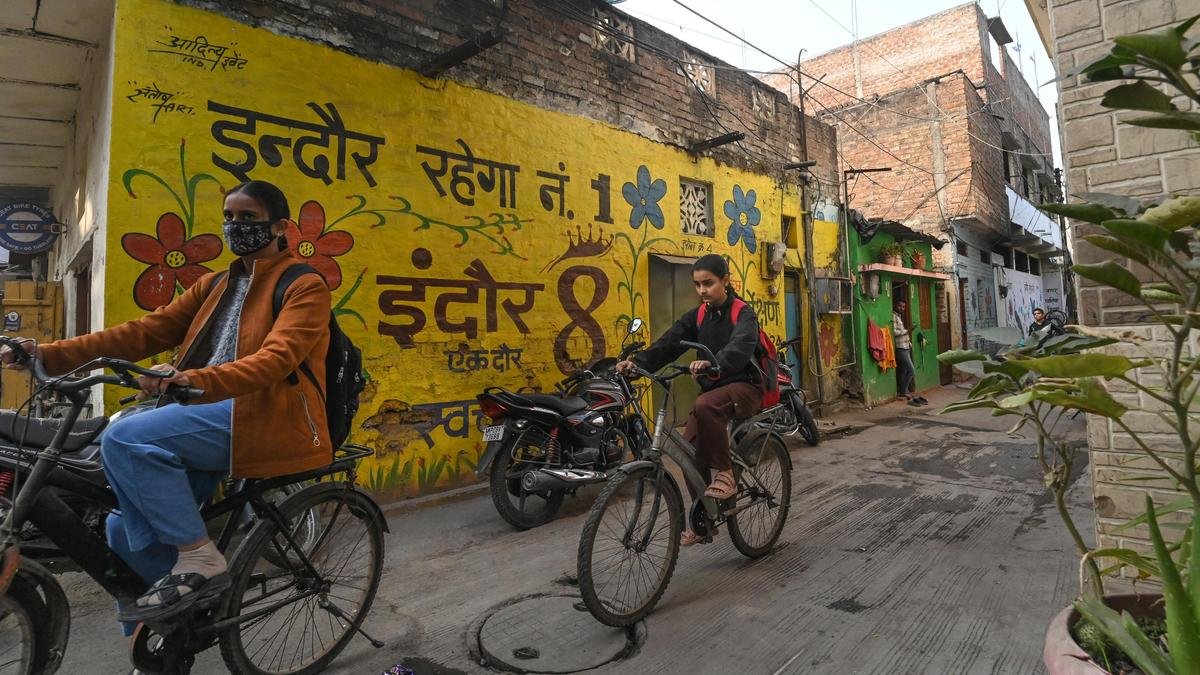
Government volunteers make rounds with bullhorn speakers, advising people against drinking pipeline water supplied by the Indore Municipal Corporation (IMC). The water has been stopped, except when the supply is being tested. Residents, mostly women, gather around water tankers to fill buckets and kitchen vessels. In the background, the walls in the locality are painted with slogans promoting cleanliness, boasting of Indore being the cleanest city in India.In the week between Christmas and New Year, as the world celebrated, Bhagirathpura, a neighbourhood of migrant and gig workers, battled a diarrhoea outbreak that affected 3,000 people. Of these, 8 died and 429 were admitted into 41 hospitals across Indore, as per the Madhya Pradesh government. Records show that 18 families were paid a compensation of ₹2 lakh each, announced for the kin of the deceased. A medical committee has been formed to verify medical records of others who allegedly died due to the contamination issue.But there were many things about the tragedy that were laced with irony, besides the fact that Indore has been declared India’s cleanest city for eight years now by the Central government’s monitoring system, Swachh Survekshan.The diarrhoea deaths were a result of contaminated drinking water from the Narmada river, considered holy. Water is piped from about 80 kilometres away, the pipes in some areas like Bhagirathpura running close to ageing sewer lines. A water test report after the deaths showed that 35 out of 80 borewells in the area also had water contaminated with a toxic mix of more than 25 bacteria, viruses, and parasites, indicating the groundwater was also compromised. The government has not zeroed in on a cause or source of contamination.This is the second tragedy within six months that has dented the brand of Indore being a clean city. In August, 2025, two infants died after being bitten by rats inside the neonatal ICU of the Maharaja Yashwant Rao (MY) Hospital, Madhya Pradesh’s largest government medical facility.While most of Indore boasts clean, wide roads and growing infrastructure, the two tragedies expose the blind spots that lie beneath. They show that basic hygienic conditions and fundamental necessities are still out of reach for many.Indore is the largest city in Madhya Pradesh and its commercial capital. Over the past decade, it has attracted several businesses, such as IT major Infosys and the real-estate Lodha Group. The city’s estimated population is 30 lakh and is growing with the influx of migrant workers from within and outside the State.Furious familiesAt Bhagirathpura’s Marathi Mohalla, set in a noisy vegetable market, Sunil Sahu’s house has an uneasy silence. A 35-year-old courier delivery executive, Sahu lost his 6-month-old son, Aviyan, in the wee hours of December 28. The family had added the pipeline water to the boy’s milk for a few days.“He fell ill on the 26th and started vomiting, so we took him to a child specialist. The doctor gave him medication and we came back. He seemed to be getting better and was fine for a day. But his condition worsened around 4 a.m. on the 28th,” says Sahu, sitting on an old sofa in his two-room house. The family immediately rushed him to a paediatric hospital in the city on Sahu’s bike, but the doctors declared him brought dead.Sahu opens his phone to a few pictures of his son. He has an 11-year-old daughter and says that they had a son after over 10 years and a lot of prayers. “My family is shattered and my wife is in trauma. I just hope the mistake the government has made is not repeated. What happened with us should not happen to anybody,” he adds.In every lane of Bhagirathpura, people have fallen sick. Some are still in the hospital, some have just been discharged, some are recovering at home with medication.In Pahalwan Gali, Alguram Yadav, 68, gingerly descends the stairs in his partly-dilapidated house. While he is still recovering from diarrhoea, his wife, Urmila Yadav, 63, could not survive and died on December 28.His son, Sanjay Yadav, says that their entire family fell ill due to the water. “A day after my mother’s cremation, my 11-month-old son fell ill. He started vomiting repeatedly and got so weak that he wasn’t able to sit. He was admitted in Chacha Nehru Child Hospital for four days. Thankfully he is better now,” he says.Sanjay says his mother, who worked as a help in a school, helped him run the house. “Even the day she fell ill, she had just come back from school. She also used to make sweet boxes for some extra money,” Sanjay adds.Unlike Sahu, Yadav is angry at the government. “For years, we used the water after only draining about 2-3 buckets when the supply starts,” he says. Piped water is only available for about an hour daily. “From mid-December, we started noticing a weird smell in the water. I don’t know what they mixed in it this time that the entire area fell ill,” he says.Even though the State government has promised to refund the money spent by the residents on treatment in private hospitals, Alguram still awaits the ₹40,000 he had to borrow for his wife’s treatment by mortgaging her jewellery.Dirt delaysWhile the outbreak came to the authorities’ attention on December 29, the hospitals — both private and government — had begun to witness an influx of patients since December 24.Indore Chief Medical and Health Officer Madhav Prasad Hasani says he was alerted by the doctor in-charge of Bhagirathpura’s government clinic on the December 29, after more than 300 cases were reported in less than a day.“As soon as we got the information, we alerted all hospitals in the neighbourhood and deployed additional staff. Patients were admitted to five government and 36 private hospitals. Additional nursing staff was provided everywhere and about eight ambulances were deployed in the area,” says Dr. Hasani.Dr. R.K. Jha, the head of medicine at Sri Aurobindo Institute of Medical Sciences, says that while people of all ages suffered from the contamination, the impact was severe for the elderly and those with pre-existing illnesses.“It gets difficult for the elderly to recover from severe dehydration,” he says. Most of the deceased are over 60. He also says that health issues build up over time, with a repeated exposure to unhygienic conditions. “The recent contamination may have aggravated problems,” he adds.Locals and IMC officials say that Bhagirathpura is an unplanned settlement. While the main road of the locality is about 15 feet wide and has the sewerage and main water supply pipelines about 8 feet apart, an assistant engineer (AE) in the IMC’s water works department says that the inner lanes are “so narrow that the two sets of pipes are on top of one another, barely 2-3 feet apart, with the sewerage network on top of the water pipeline”.While the existing water supply network in the area was laid down using iron pipes between 1997 and 2000 with the Narmada water supply starting a few years later, the sewerage network dates back to before the 1990s, say officials. They warn that there are several other Bhagirathpuras in Indore.A senior IMC official also admits to delays in repair and replacement work across the 10-kilometre network. Bhagirathpura residents say they have been raising the issue of dirty water with local representatives as well as through the IMC’s 311 mobile application for over a year.In a letter dated February 28, 2024, ward no.11, under which Bhagirathpura falls, councillor Kamal Baghela had written to Indore Mayor Pushyamitra Bhargav, saying that residents had been getting hospitalised with typhoid, jaundice, and fever due to contaminated water. Baghela says that after his complaints, Bhargav had inspected the area and issued instructions for repair and replacement works. Baghela, however, has now been facing the heat of local residents who allege that he did not act on their complaints.The AE, who does not want to be named, says, “About 20% of the main water supply line was either replaced or repaired, but the work to replace the entire network, including the distribution line, could not start.”The project to replace the entire water supply network of Bhagirathpura had been cleared, but a company was not contracted until people died. The tender bid was hurriedly finalised and allotted on December 31.While the work to lay fresh pipelines is under way, officials of the municipal corporation are also working to trace any leakages and repair them. They are chlorinating various supply points, including borewells. “Water supply will only be resumed after all leakages have been traced and fixed, and multiple tests are conducted to ensure that there is no contamination left,” says Indore Divisional Commissioner Sudam Khade, who is leading the government’s efforts.Newly appointed IMC Commissioner Kshitij Singhal says that more than 400 private borewells have been chlorinated and 87 have been disconnected.A toilet at the local police outpost built over the main water supply line, which was initially suspected as the source of contamination, has also been dismantled. The toilet was operational without a septic tank.Various teams from government agencies are trying to investigate multiple aspects, including the causes of contamination, but there is no clarity on this yet.Many people in Indore are now scared of water that comes through the corporation pipeline. They are buying water or installing RO devices.
Since the corporation water supply has been cut off, residents rely on purchasing water from private suppliers for drinking and cooking.
| Photo Credit:
A.M. Faruqui
Power pummellingThe first fingers after the deaths were pointed at the IMC, dominated by the BJP. Additional Commissioner Rohit Sisoniya, who handled eight departments, and Superintendent Engineer of its Public Health Engineering Department, Sanjeev Shrivastava, were suspended. The Commissioner, Dileep Yadav, was transferred out of Indore.Indore is the hometown of Madhya Pradesh’s Minister of Urban Development and Housing Kailash Vijayvargiya. Chief Minister Mohan Yadav had put himself in-charge of the district since August, 2024. Bhagirathpura falls under Vijayvargiya’s Indore-1 Assembly constituency.A senior BJP insider in Bhopal says, “The rivalry between the two leaders is not a secret. The CM looks to assert dominance across the State while Kailashji does not want to cede his home turf at any cost. In several instances, the party high command has had to intervene during disagreements between them.” He adds that most local elected leaders in Indore are loyal to Vijayvargiya, while senior officials are posted from Bhopal. He says that while the two tussle, Indore suffers. Delays are part of the disruption of citizens’ daily lives, says a councillor from a neighbouring ward. He claims he moved from the Congress to the BJP ahead of the 2024 Lok Sabha election to get projects cleared.“From July 2022 (when the civic body elections took place) and when I joined the BJP, I could only get works worth about ₹35 lakh approved for my area. Since 2024, works of about ₹18 crore have been cleared in my ward. However, several major projects are still pending as officials do not listen to us or even talk to us properly,” the councillor says. His reference to officials signals the Chief Minister’s appointees.Mayor Bhargav, however, who is also an elected representative, denies any major tussle. “This is a very tragic incident for Indore and we take full moral responsibility for this. If there are any minor issues or communication gaps among us, we will overcome them and work together, because the priority is to fix the shortcomings and ensure that such a tragedy is never repeated in the city,” he says.Indore residents like Mukesh Maurya though, are tired of back-office politics. Maurya’s 72-year-old father suffered a cardiac arrest allegedly due to complications from the diarrhoea that hit so many. “My father has barely survived. I ran from hospital to hospital because nobody was willing to admit him on December 29,” he says.The bigger picture, he feels is he feels, is something else. “As citizens, we work hard and pay taxes on almost everything, but these politicians can’t even provide us with clean water to drink. Are we asking for much here?”Edited by Sunalini Mathew
已Opublikowany: 2026-01-11 22:40:00
źródło: www.thehindu.com